Other types of fibers

alpaca yarn
jute fibers
            
o   Fibers are the smallest measures of textile materials, and are naturally composed from plants and animals, or are manufactured. The type of a fiber, its commonness and rarity, as well as the way it is made into fiber, helps identify how useful a specific fiber will be in uncovering people involved in a crime. For example, cotton, which is one of the most common plant fibers, would be less beneficial than another less common plant fiber such as flax, jute, hemp, or kapok (enotes and google.com). In some cases, however, fibers can increase in significance due to certain characteristics they have. For instance, depending on its type, length, degree of twist, or processing technique, cotton could increase in importance. Similarly, a common animal fiber, wool, would be more difficult to identify than other animal fibers like camel, alpaca, cashmere, or mohair. Still, various characteristics such as the coarseness of the fiber, the diameter, and the degree of scale protrusion could contradict that conclusion. The third fiber type, manufactured, is the most common found fiber in textiles. They can originate either from natural materials or be entirely synthetic made. The most common kinds of manufacture fibers are polyester and nylon, but rayons, acetates, and acrylics are also encountered. Besides the kind of fiber, the amount of production, the end use, the cross-sectional shape, microscopic characteristics, and other traits could affect its importance. Other variables of fiber identification include the color, number of fibers found, fiber location, fabric types, nature of contact, multiple fiber association, volume of fiber production and fiber transfer and persistence (google.com).

Hair/fiber collection techniques


http://www.nij.gov/training/firearms-training/module06/images/fir_m06_t04_01.1.jpg
o   Depending on the circumstance, collection of hair evidence can be performed in numerous ways. The first type of collection for visually observed hairs can be gathered with the investigators hands or with tweezers. When choosing tweezers, however, note that they can cause damage to the hair structure and may hinder DNA analysis by crushing the delicate root structure and surrounding tissue.  The next kind of collection for observable or unobservable hairs utilizes clear tape to lift up the evidence from various surfaces. With this approach, be cautious that fibers from the source do not obstruct your evidence by sticking to the tape. The third technique, vacuuming, is employed in large crimes scenes where major points of transfer are unidentified or on stationary objects that cannot be moved elsewhere.  Another way to gather hair evidence is by brushing, scraping, or shaking the observed material over a white sheet of paper to wear down and remove hair attached to the article. This process would require the separation of detached trace evidence into categories such as hair, fiber, or glass. A similar approach to collect hair evidence would be to place materials in a bag and agitate it. The benefit of this is that all evidence is completely caught in the bag. The last method of collection is accomplished by combing or clipping any loose hairs from either a suspect or a victim. A sufficient amount of scalp hair is roughly 100 hairs and 30 to 50 for other areas of the body.
o    http://dofs.gbi.georgia.gov/00/article/0,2086,75166109_84393031_84525445,00.html#fibers 
http://www.evidentcrimescene.com/cata/evid2/envelopeGlassine.jpg
o   Fibers from items such as clothing, are often found in cases involving an individual’s struggle. When handling evidence, be sure to separate the location of the suspect and the victim so they are not confused with each other. Try to collect the entire item under investigation, however, if this is not possible, first perform a tape lift on the item and then complete a fiber standard of it. To collect transferred fibers, use a clean plastic surface for transport rather than using paper or cards because it may prevent their recovery and comparison. If there is any indication that the victim and suspect contacted a specific source, fiber standards, or known samples, should be taken.

Typical hair/fiber analysis

o   There is no exact procedure scientists use to analyze fiber, however, microscopic examination with longitudinal and cross sectional samples is a common method. Other tests such as burning, solubility, and color can also identify fiber (chymist.com). Similar to fiber analysis, hair analysis is usually done by light microscopy. This process involves two steps; first identify the questioned to hair and second to compare the questioned hair to the known hair. The identification of hair depends on how distinctive its properties are, which can be seen through comparison microscopy. Comparison microscopes have two compound light microscopes that are connected by an optical bridge that allow for the microscopic observation of two different hairs at the same time. It is hard to determine a statistical probability for a hair match because there is no exact way to quantitatively assess the microscopic characteristics in hair. To examine an unknown hair, first identify where it is from such as an animal or human then continue to analyze more specifically its type such as dog breed. Factors that affect analysis include experience, training, suitability of known hair standards, and adequacy of equipment (fbi.gov).
o     http://www.chem.sc.edu/analytical/chem107/lab4_032205.pdf
o     Similarly, hair evidences can be analyzed with microscopes using side-by-side comparison. This identify can classify race, region of body, length, color, and how the hair was removed. While it is unlikely that hairs from different people will look exactly the same under microscopic examination, it is possible. To be certain, hair evidence should examined through mtDNA sequencing because by it will verify that the identification of the hair is accurate. The drawbacks of mtDNA are that there is a greater cost, increased time period, it may not always be possible to completely extract DNA, there may not be enough tissue present, and the process destroys hairs. Thus it is important to still preform a microscopic examination and to consider all the factors involved with mtDNA sequencing.

Reliablitity of hair/fiber

o
o   http://www.ehow.com/about_5640929_forensic-science-hair-fiber-identification.html
o   Analysis of hair and fiber evidence can be helpful both in convicting felons and liberating the falsely accused. However, when utilized as definitive data in crime scenes, their reliability is inconclusive. In hair analysis, there are has not been enough research completed to compare the accuracy of the test in a statistical way. Still, when extracted from the hair, DNA can be deemed as an accurate means of testing. In contrast, fiber evidence can be determined as an accurate match with another source by lone statistical elimination.

Notable/famous use of hair/fibers

o   In 1990, a young girl found her mother, Eva Shoen, dead from a gunshot in the head. The police looked into obvious leads such as the bullet and Eva’s husband but they led to nowhere. Three years later, the police received a call from a man who believed his brother, Frank Marquis, was to blame. In their investigation, they found that Marquis had been in town for a festival and that he had a police record for rape. They also learned that on his drive back from the festival he had tossed two bundles out of the car, most likely clothes. Detectives narrowed the possible locations and found that a construction crew had recently uncovered a bundle of clothing in a pile of dirt. On a shirt they were able to find a single strand of hair and examine it against a hair sample taken from Eva Shoen. They were a close match and the police was able to acquire a confession from Marquis, however, it was for a lesser crime. Marquis’s plea bargain gave him twenty four years in prison for manslaughter.

History of Fingerprinting

o   The exact time that fingerprinting first appeared is undetermined, however, evidence is shown for it occurring in Egypt in 2000 B.C.
o   The Chinese uses fingerprints on legal documents; however there is later an argument over if their purpose was to identify individuals or rather for spiritual practices.
o    In Persia in 1350, official documents had evidence of fingerprints, but whether their purpose was to identify individuals is still in question.
     §  One government official questioned if there were any two fingerprints exactly alike.
o   In 1686, Marcello Malpighi identified fingerprints having ridges, spirals, and loops in his treatise. There was no indication that they could be used for identification
o   In July 1858, Sir William James Herschel introduced fingerprints by using them in his native contracts. At first his aim was not to use them for identification, but he began to notice that each fingerprint was unique as well as permanent. This led him to expand their use.
o   In 1863, Professor Paul-Jean Coulier observes that latent fingerprints can be developed on paper by iodine fuming and explains how to preserve or them. He also notes that they could possibly be used in identifying suspects.
o   In 1880, Dr. Henry Faulds is credited with the first fingerprint identification of a greasy fingerprint left on an alcohol bottle.
o   In 1882, Gilbert Thompson brings fingerprints to the U.S. to prevent forgery on a t=document.
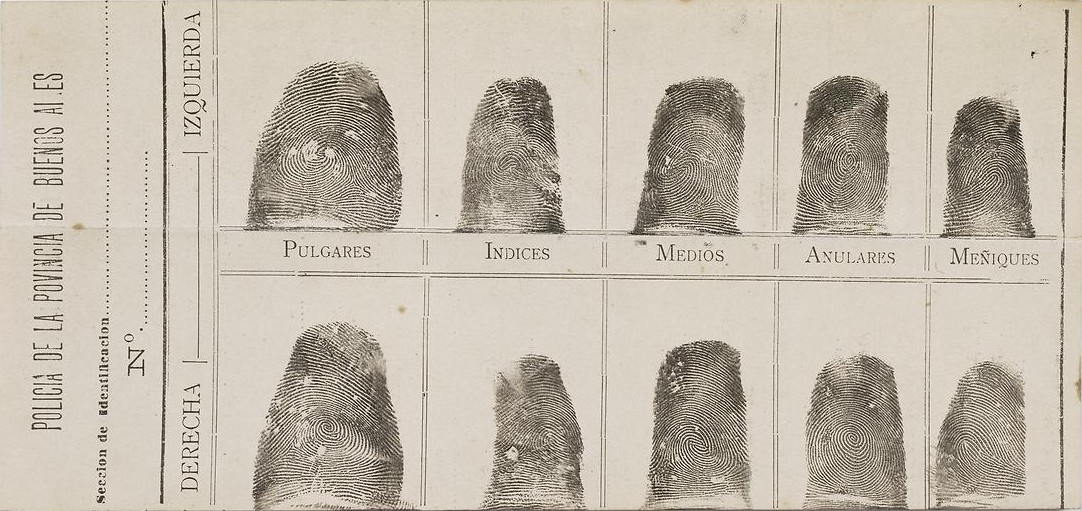
o   In 1892, Juan Vucetich was the first to use a fingerprint to identify a criminal.
o   In 1892, Sir Francis Galton published a book that stated fingerprints were unique and permanent. He also created an identification system for them.
o   In 1902, Henry P. DeForrest  as part of the New York Civil Service Commission, brings fingerprinting to the U.S.
o   In 1903, the New York State Prison system is the first to fingerprint criminals.
o   From 1905 to 1908, the U.S. military and the Department of Justice begin using fingerprints.
o   In 1918, Edmond Locard writes that if 12 points are the same in two fingerprints then they are the same.
o   In 1924, the U.S. Congress establishes the Identification Division of the FBI.
o   In 2005, INTERPOL's Automated Fingerprint Identification System collects over 50,000 fingerprints for important criminal records from various countries.
o   In 2011, the U.S. Department of Homeland Security contains the largest AFIS repository, which contains over 100 million records. Additionally, all US States have individual AFIS databases.

Types of Fingerprints

o   There are three common fingerprint types; impressed, visible, and latent. Impressed or Plastic fingerprints are indentations left in soft and pliable surfaces. Examples such as clay, wax, paint, will take the prints impression, thus they are able to be viewed or photographed without development. Visible, or patent prints, are fingerprints in some medium that reveals them to the naked eye. For instance, if blood, dirt, ink or grease was left on a finger and the finger came in contact with a smooth surface, it would leave a friction ridge impression that you could see without development. Oppositely, Latent prints cannot be seen by the naked eye. This is because they are formed by sweat or the water, salt, amino acids, and oils found in it. In order for the prints to be seen they must be developed through processes such as dusting, fuming, or chemical reagents